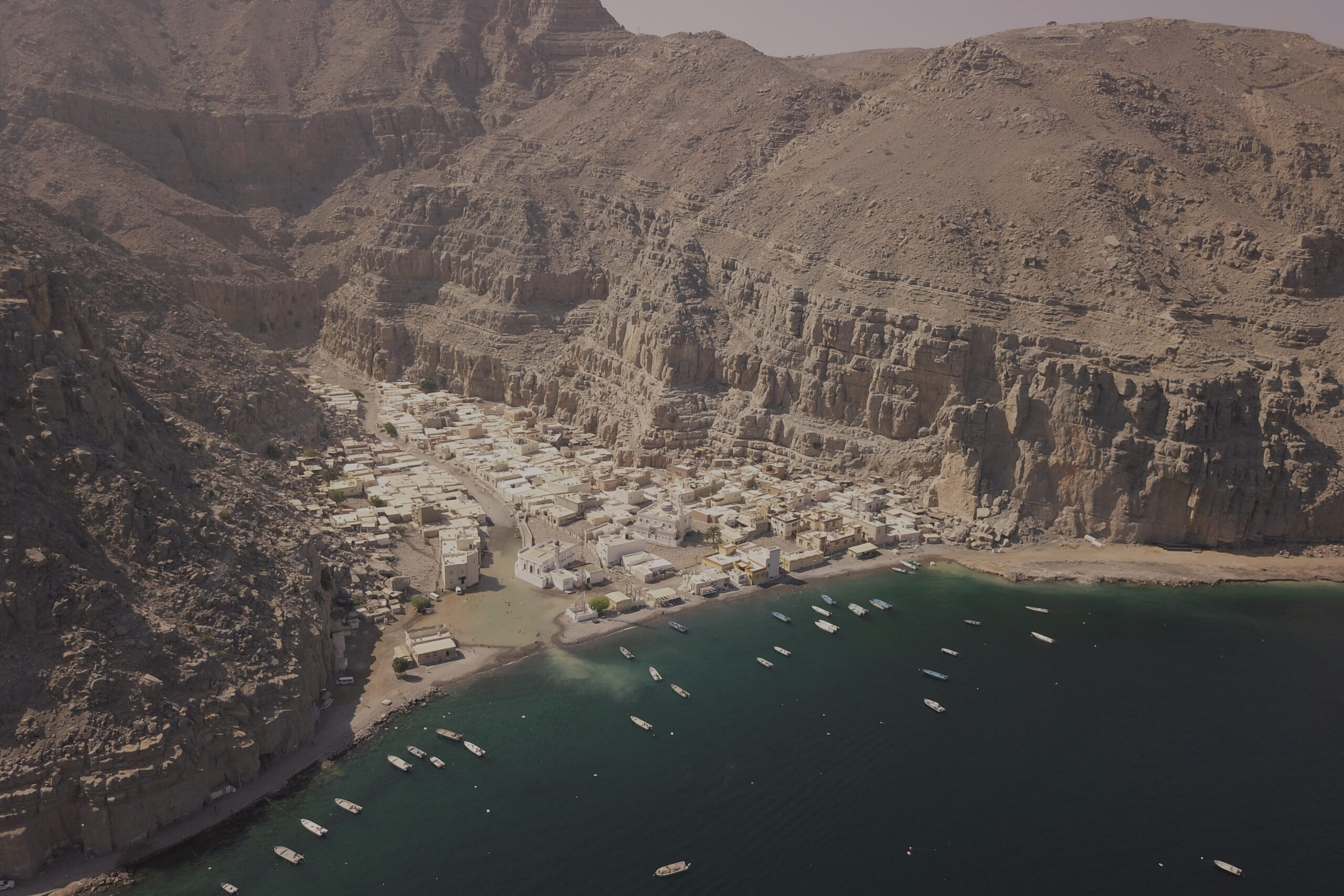
Kumzar (كُمْزَار in Arabic) is a remote village located in the Musandam province, governorate of the Sultanate of Oman.
It lays in one of the most strategic trade arteries of the world, the Strait of Hormuz in thePersian Gulf, between Oman and Iran, through which the majority of the world’s oil exports are transported; however, it is very isolated and can only be accessed by boat.
The village is the second most populated town in the north of the country, and the northernmost among the inland population centers.
Kumzar has been inhabited for about 500 years, although it is not clear since when exactly. Already the first maps drawn by the Portuguese marked a settlement in the area where the city is today.
For centuries, Kumzaris have had frontrow seats to history. They have witnessed and even assisted invading armies of the world’s great empires that have sought control of the Straight crucial to global marine trade.
The easiest way to get to Kumzar has always been from the mainland by boat.
Today it’s possible to reach the isolated village with a speed boat or typical Dhow from Khasab. Khasab is a small town exclave of Oman bordering the United Arab Emirates. It is the local capital of the Musandam Governorate, and has frequently been called the “Norway of Arabia” because of its extensive fjord-like craggy inlets and desolate mountains capes.
From a geological perspective, although these spectacular inlets look identical to Norwegian fjords, they were not carved by glaciers. Instead, the Musandam Peninsula is undergoing a massive tectonic subsidence (crustal drowning) caused by the Arabian plate colliding and pushing beneath the Eurasian plate. This collision forces the rugged limestone valleys to literally sink below sea level, allowing the waters of the Persian Gulf to flood the canyons and create this otherworldly landscape of sunken valleys.

The geographic area of Musandam, where Kumzar is located, characterized by huge rock formations, constitutes within it a protected area of fjords and inlets, and outside a very rugged coastline, very exposed to the winds and the open sea, where hardly any vegetation lives; but the sea is teeming with life. Flocks of seabirds hunt for fish among schools of leaping tuna.
Despite Kumzar being on the coastline, facing the open sea, it finds space between the inlets of a canyon, nestled in a fairly protected bay.

ABOVE: aerial view of the gulf town of Kumsar
The Kumzar village counts about 3000 inhabitants, mainly are families, and most of them are composed of several children; as we were told about an average of 5-6 children per family.
Across Oman, the depopulation of rural communities is common, but local reports say that high birth rates in Kumzar led the village to grow in population by around 300 people a year.
People live in total harmony with their cohabitants, the mountain goats, that you can find walking around and climbing the rocks.


ABOVE: aerial view of the gulf town of Kumsar
Most of the population, however, is semi-nomadic.
In the fall, winter and spring they fish and live in Kumzar. In the summer, due to the rising temperatures on the gulf reaching up to 50 degrees Celsius, most of the population abandons Kumzar to settle in the nearby port town Khasab where they harvest dates, and where they own their second houses.
This annual summer migration is locally known as the Ghaydah. For nearly three months, Kumzar turns into a literal ghost town with locked doors, as the entire community shifts its economic focus from marine fishing to oasis agriculture. This ancient nomadic rhythm perfectly balances the exploitation of sea resources during the cooler seasons with the strict demands of the date palm harvest when the gulf waters become too hot and oxygen-depleted for intensive fishing.
The liveliest place in town is the school. Girls and boys in white uniforms sit in the comfort of an air-conditioned trailer, studying different subjects.
But after school you can find them swimming in the sea and playing all together on the seashore.
There isn’t much to do in Kumzar at night. There are just two restaurants, three shops and two mosques.


ABOVE: inside a traditional family house in the ancient caravnan town of Ghadames
Kumzari houses are built extremely close together. In fact, the only gap among the crowded houses is a narrow drainage channel for the village.

ABOVE: aerial view of the gulf town of Kumsar
Houses are made from stone and have tiny courtyards and flat stone roofs. The entire village is surrounded by tall mountains on all sides except one. This open side gives the people access to water and is where most of the daily activities occur. There is no room inside the village interior for such activities, since it is completely compacted with homes.

ABOVE: view of the gulf town of Kumsar
The main diet of the Kumzari consists of goat milk, cheese, goat meat, mutton, and fish. Figs, coffee, and canned foods are also consumed on a regular basis. At mealtime, mats are placed on the ground, and the food is placed on them. Men and women sit in separate circles with other family members, sharing food from a tray on the mat.
Language
Kumzaris speak Kumzari (Arabic: لغة كمزارية, Luri: کومزاری), a Southwestern Iranian language that is similar to the Larestani and Luri languages. Although vulnerable, it survives today with between 4,000 and 5,000 speakers.
This is the only non-Semitic language spoken exclusively in the Arabian Peninsula.
Kumzar’s geographic isolation may have helped the local language survive in a country where the majority of the population speaks Arabic.
Kumzari is a mix of Arabic, Persian and Hindi, with some borrowed English and Portuguese, adopted from the European sailors who have traveled for centuries through the Strait of Hormuz and stopped in the village for some water and rest.
Linguistically, despite this heavily layered vocabulary borrowed from maritime trade, Kumzari maintains a core structural and grammatical foundation that classifies it as a Southwestern Iranian language. It operates as a distinct offshoot of ancient Persian, preserving archaic phonological traits that have long vanished from modern Farsi, making it a living verbal fossil trapped inside a geographical pocket of the Arabic-speaking peninsula.
UNESCO has categorised the language as “seriously endangered” with linguists saying it could die out in the next 50 years.
Despite the rumors concerning the possible extinction of the Kumzari language the locals put a great deal of importance on the preservation of the language; though our conversations with them is understood that the language is passed down to the new generations which, as already mentioned, constitute a large part of the demographic growth of the village.

ABOVE: view of the people of Kumsar
Furthermore another rumor, that the Kumzari language does not find its written form, has been dispelled. As we have been told, the language is written by people, but most probably there is no official documented linguistic structure, such as a vocabulary or a documented grammatical construction.

ABOVE: view of the gulf town of Kumsar
Economy
Appearances can be deceiving, and though one might not think it from first glance, the Kumzari actually enjoy a high quality of life.
The Kumzari are primarily fishermen.
Fishing is the main source of income, and tuna and sardines are the most commonly caught fish.
Men also build the houses and conduct the agricultural activities, collect honey, and shear, slaughter, and skin the animals.
The women process agricultural products, feed and milk the animals, make butter and cheese, and engage in all the domestic duties, such as carrying water, cooking, and sewing. Others work as sailors, boat builders, merchants, or craftsmen.
A few men have also gone to work in the oil fields of Oman or the United Arab Emirates. They are diverse in their careers and some work as doctors, nurses, business men and women, poets, writers, engineers and teachers.
At first inspection, Kumzar seems entirely cut off from civilisation, but looking more closely you can see signs of the modernisation of the area, which happened in the past 10 years or so, thanks to the help of the Omani Government. Besides electricity, it brought running water, a school and a hospital, satellite television and Internet access to the village.
There is also a helipad where passengers wait for the helicopter. Twice a week it takes residents back and forth from the provincial capital.


ABOVE: view of the people of Kumsar
Religion
The village religious practice is based on Islam, but with the traditional folklore of the region, which makes it a culture that distinguishes it from other Arab settlements in the area.
The Kumzari are entirely Muslim, following the teachings of the Koran. Like many other Muslim peoples around the world, and as many other religions, they have their own type of folk Islam, which combines Islam with their pre-Islamic practices. They believe in evil spirits, which are warded off by cowrie shells tied to the bows of their boats. They believe in a she-devil who casts shadows and walks around in rags, carrying a basket.
They also believe in monstrous creatures of various kinds.

ABOVE: aerial view of the gulf town of Kumsar
Sources & References
- On the Kumzari Language & Endangered Linguistics: Anonby, E., & Yousefian, P. (2011). Adaptive Sociolinguistics: The Kumzari of Oman. Iranian Studies Series, Leiden University Press. This definitive linguistic survey explores the vocabulary, grammar, and sociolinguistic resilience of Kumzari, documenting its unique position as the only non-Semitic indigenous language of the Arabian Peninsula.
- On Tectonic Subsidence & Musandam Geomorphology: Vita-Finzi, C. (1979). Rates of tectonic uplift and subsidence in Northwest Oman. Geological Magazine. This structural study details the crustal drowning and tectonic subsidence of the Musandam Peninsula, explaining the geological formation of the fjord-like inlets and ria-coastline surrounding Kumzar.
- On Semi-Nomadic Anthropology & The Ghaydah Migration: Lancaster, W., & Lancaster, F. (2011). Honour is in Contentment: Life before Oil in Ras al-Khaimah and Oman. Centre for Overseas Research and Development, Durham University. This anthropological research documents the maritime and agricultural life of the Musandam communities, detailing the socio-economic dynamics of the summer date harvest (Ghaydah) in Khasab.
- On Maritime Folklore & Syncretic Religious Practices: Donaldson, B. A. (1938) & Modern Ethnographic Records of the Sultanate of Oman. Academic documentations of folk Islam along the Persian Gulf archive the survival of pre-Islamic protective rituals, such as tying cowrie shells to dhow prows to ward off evil marine spirits (jinn) and sea monsters.


